
The search opportunity playbook
A practical framework for connecting customer demand, search discovery and business decisions. Includes a clearly labelled hypothetical planning example.
Start with the decision, not the channel.
A stronger search plan starts with a question the business needs to answer. Do you need more suitable enquiries, a clearer view of paid media efficiency, or a better understanding of how customers discover your expertise? Write that question in one sentence before opening a channel report.
Then define the outcome. A visit, an enquiry and a qualified sales opportunity describe different stages of a journey. Decide which matters to the decision, how it will be identified and who can confirm its quality. If the answer is not available yet, make that a task in the plan rather than filling the gap with an assumption.
Map demand, discovery, decision and value.
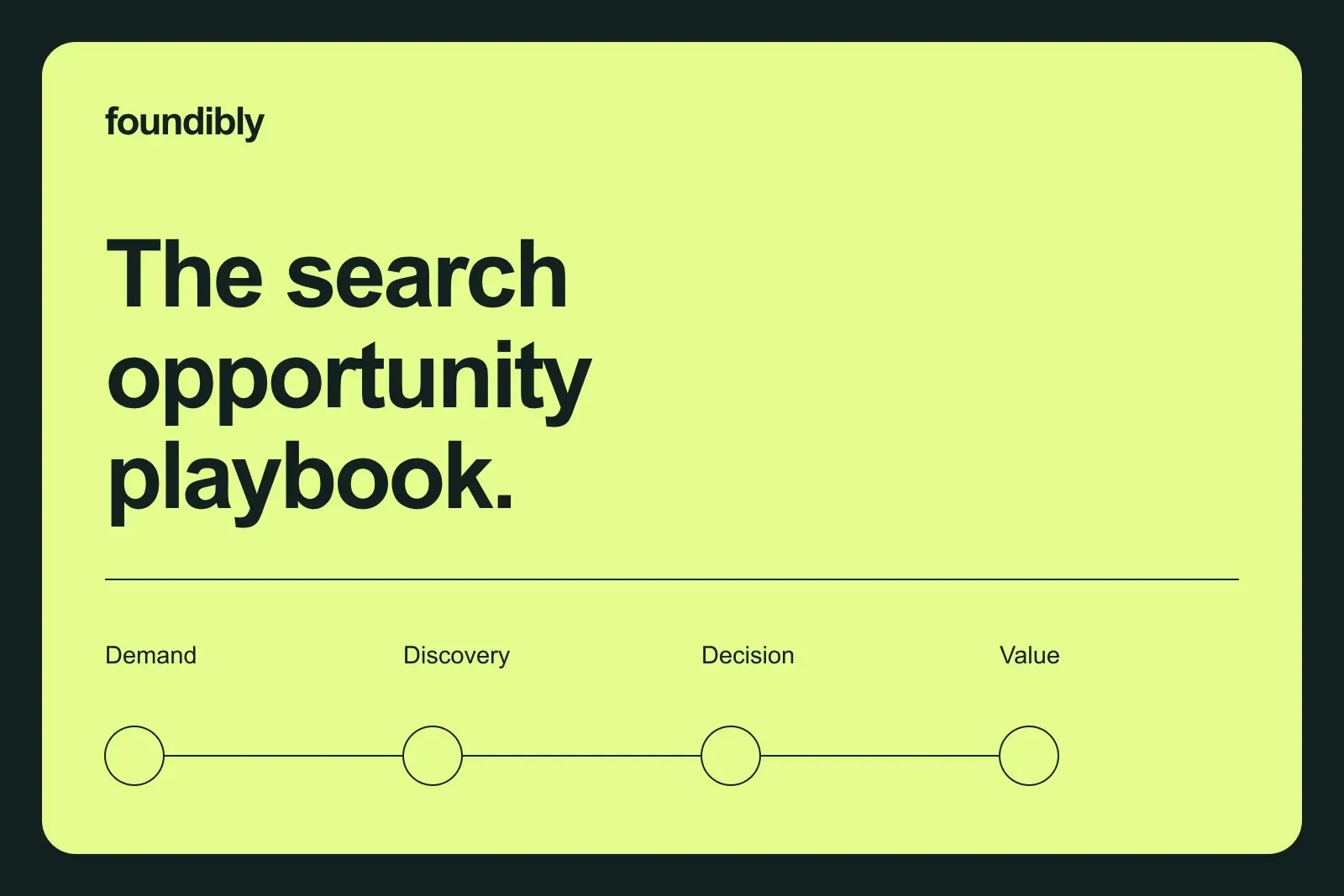
Use four lenses to organise the discussion. Demand asks what customers need and how they describe it. Discovery asks where the business can be found. Decision asks whether the page or experience helps someone take a useful next step. Value asks what happened after that action.
For each lens, capture one observation, the evidence behind it and the next question. A small, well-explained set of observations is more useful than a large collection of disconnected screenshots. Include the date range, comparison and scope so another person can understand what they are looking at.
Find the friction worth investigating.
Look for a gap between what the business wants and what customers can currently do. A priority capability might be difficult to find. Paid enquiries might be plentiful but unsuitable. A useful guide might answer the early question without helping someone explore the relevant service.
Describe the friction without jumping straight to a solution. “The page needs a redesign” is already a proposed answer. “Customers cannot easily find the information needed to compare our service” gives the team something to investigate. Record what would make that explanation more or less convincing.
Turn observations into a prioritised backlog.
For every proposed action, write down the business question, supporting evidence, intended outcome, owner and dependencies. Estimate effort and the confidence you have in the explanation. Discuss potential value in the context of the business rather than treating an arbitrary score as certainty.
A practical first backlog usually includes a measurement task, an improvement to an existing journey and a question worth testing. This is a planning suggestion, not a promise that three tasks will produce a particular result. The right sequence depends on the site, market and team.
A worked example: the enquiry quality question.
Hypothetical example: a B2B manufacturer has enough website enquiries, but its sales team says too many are unsuitable. The first question is how “suitable” is defined and recorded. The next is whether the source, landing page and enquiry topic can be reviewed together.
An example plan could start with a simple qualification definition, a review of the relevant landing pages and a small test of clearer capability messaging. Before the test begins, agree the comparison period, who will assess the enquiries and what other changes could affect the interpretation. No invented uplift is needed to explain why the test is useful.
Make the first 90 days a learning plan.
Days 1–30: agree the decision, understand the starting point and check the evidence available. Identify the people and dependencies that could affect delivery.
Days 31–60: implement the agreed priorities and run the first proportionate tests. Keep a decision log so the team can see why a change happened.
Days 61–90: review what changed, what remains uncertain and which questions deserve the next investment. Ninety days is an illustrative planning window, not a guaranteed timeframe for SEO, revenue or any other result.
Bring these questions to your next review.
- What decision should this report help us make?
- Which outcome matters, and how is its quality confirmed?
- What is the source, period and scope of the evidence?
- Which alternative explanation could change our conclusion?
- Who owns the next action, and what needs to happen first?
- What will we review before deciding to continue, change or stop?
Use the answers as a conversation starter. The value is in a clearer shared plan, not in completing a template for its own sake.

Jonny Turner
Jonny connects experience across websites, ecommerce, user experience, SEO and paid media with the commercial questions behind a search brief.
Meet JonnyExplore the related services.
Put a clearer search plan into motion.
Tell us which question your business needs search to answer. We’ll help you explore a practical next step.